"He's so stupid. Why did he ask such a stupid question in class?" asked Tactless Girl. "I can't believe he would ask the lecturer for an organisation and then asked how to calculate something that's already given! So stupid!"
What was our reaction? Silence. I felt uncomfortable and glancing around the table, I could see that my other group members were also not used to this kind of judgmental outbursts that no one dared to acknowledge or agree to. In the end, I just said, "wow, I don't think I would've dared to ask the lecturer that this late in the semester" and moved on to our research project.
Reflective Observation
When I got home, I thought about the way she said it and actually felt bad for the guy. I've always gotten the sense that he had a language barrier and that he was a little lazy during class. I've had him in my group and I've seen that he doesn't do much to try to figure things out on his own. But to call him stupid? I thought that was going too far...
I've always disliked it when the word stupid is used not to describe someone's actions, but the person itself. It's condescending and it's vulgar. It's not the same as me saying to Lester, "eee... stupid oh you..." to which he answers, "you lah stupid". In this case, TG was convinced that he was stupid.
I remember walking home and thinking, "if she can say this about that guy, I wonder what she can say about me?"
Abstract Conceptualization
Chris Argyris' theory of beliefs and the ladder of inference is obvious in this scenario.
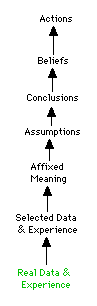
What the diagram implies is that we begin with Real Data & Experience, the kind that would be captured by a movie camera that didn't lie. We then choose a set of Selected Data & Experience that we pay attention to. To this Selected Data & Experience we Affix Meaning, developAssumptions, come to Conclusions, and finally develop Beliefs. Beliefs then form the basis of our Actions which create additional Real Data & Experience (http://www.systems-thinking.org/loi/loi.htm)
In this case, my beliefs about TG has somewhat changed since I first met her in March this year. My initial opinion was that she was a nice girl, clever, hard-working, professional, etc. But throughout this semester, I have seen her being rude, condescending and insulting to others, even to myself. This experience has led me to looking for other signs and validation, and it seems that the more time I spend with her, the more I lose my respect for her, to the extent that I'm questioning the numerous opportunities given to her - scholarship, internship, office job - and that I'm downright jealous! Hence, I now believe that one shouldn't get too close to her, at the risk of being called 'stupid' and then gossiped about to other people.
Argyris also says that once these beliefs have been formed, it's really difficult to erase them and start with a clean slate. This is too true.
Active Experimentation
What would I have done differently? I should have told her that it's not nice to talk about people like that, especially if you are talking to a group of people you are not close to. No matter how 'silly' the question, he has the right to ask especially if he wants to pass the subject. There is no need to pass judgment, after all, we are not so perfect ourselves.

No comments:
Post a Comment